12.10.26
While decentralised controls using intelligent drives have been popular with machine-builders, higher demands on machine complexity, combined with advances in controller processing power and communications, is making centralised architectures more attractive. Dario Dallefrate, director of strategic marketing at Trio argues they allow faster machine development, especially when motion control is required.
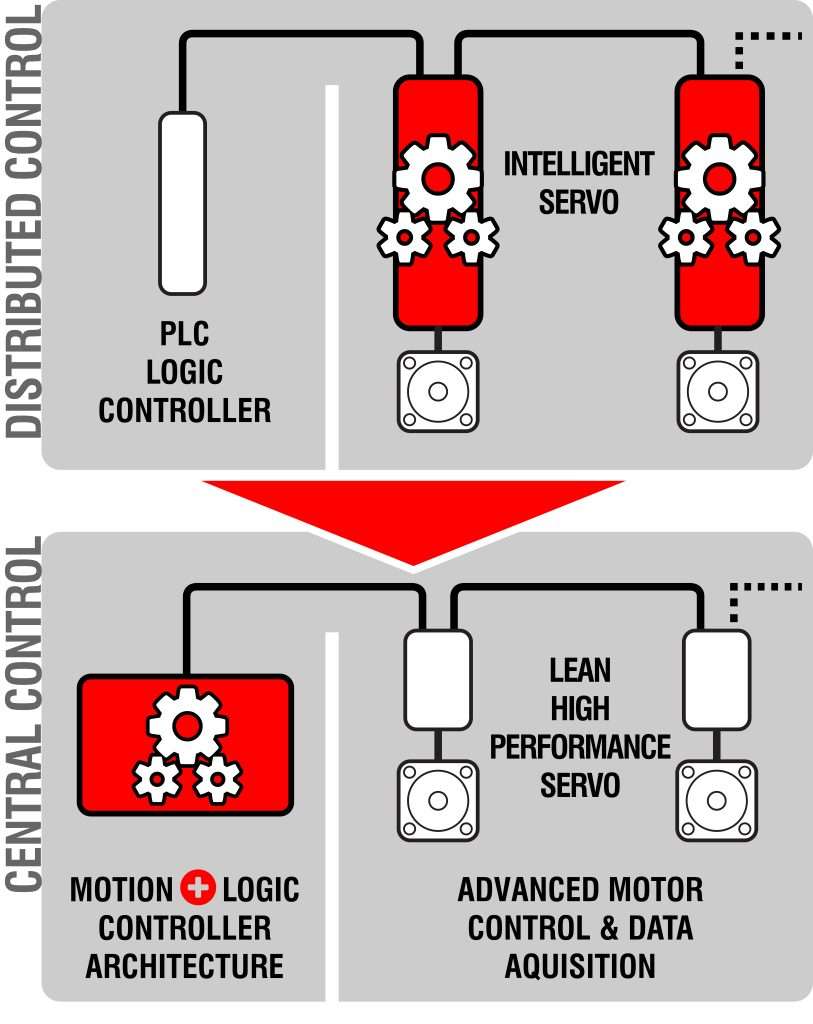
In recent years, many automation players have been promoting the advantages of decentralised control to machine-builders. This approach means using “intelligent” drives, tasked with controlling the motor, as well as managing I/O and elements of machine logic. Now though, the demand of more sophisticated machines, combined with advances in computational power and real-time connectivity, is changing machine architectures.
Instead of using multiple intelligent drives, machine-builders are transferring intelligence to the latest generation of capable motion controllers, combined with “lean” high-performance drives with reduced logic capabilities but enhanced control of servomotors. For machine-builders, this means machines that are easier to use and less expensive to develop, as well as offering enhanced performance.
The CPUs used in the previous generation of automation technology had much less processing power than today. These CPU limitations in PLCs forced distributed control architectures, including the adoption of multiple controllers and programmable devices to create complete machines.
What’s more, fieldbus networks were less capable of transmitting data with the speed and determinism required for motion control applications. While machine controllers were focussed on managing sequential machine logic, the computationally intensive role of controlling servo axes was handled by drives. Equipped with dedicated processors to manage current, velocity and position loops, these drives were located close to the motor to reduce lags in communication.
The proliferation of fieldbuses also required drives to integrate option cards or communications stacks. As a result, drives became more flexible to accommodate varying machine architectures, machine I/O, programmability, and advanced peripheral devices. However, this extra flexibility added cost and complexity to every axis.
Today, end-users demand more advanced machines and production lines across all verticals served by discrete automation. Consider packaging, for example: end-users want fast format changes to adapt existing lines rapidly to new products, as well as full food traceability to safeguard consumers, and safer machines to improve operator working conditions and satisfy regulations.
These market needs have driven demand for more sophisticated machines, and the rapid acceleration in computing power, including advances in microprocessor technology and deterministic real-time networks, has enabled more powerful, centralised motion architectures.
The latest generation of machine controls can incorporate PLC functions, plus the ability to integrate a wide variety of peripherals such as cameras and other sensors. They can also coordinate all machine axes in one place, including cross-axis behaviour not possible with independent, intelligent drives. In turn, the need for decentralised solutions is becoming less compelling.
The rise of the lean drive
The emergence of high-powered machine controllers that combine motion control and PLC functions has reduced significantly the need for intelligent drives, and this has provided machine-builders with several advantages.
They can now design leaner architectures with less complex components, resulting in systems that are easier to manage. Specifically, application development is much simpler, resulting in a faster time to market. A single controller that integrates all machine I/O makes interfacing of devices much easier, reduces programming, and simplifies builds. The streamlined control architecture also makes machines much easier to use, maintain, and troubleshoot, with fewer points of failure, enhancing reliability.
Because the shift in control architecture has enabled automation vendors to strip away unnecessary intelligence from a drive, this also means lower costs per axis. More capable controllers incur some cost increase, but the larger the number of motor axes, the greater the cost saving.
Considering performance, an important advantage of the lean drive is that removing non-essential intelligence allows it to focus processing power where it matters most – at the motor. With machine-level logic, I/O processing and other functions handled instead by the controller, a lean, high-performance drive is dedicated purely to servo control. The result is improved tuning and shaft performance, and increased use of the motor as a sensor, enabling more effective maintenance and diagnostics. What’s more, these gains are achieved with easier overall set-ups, only requiring parameters focused on motion control applications, rather than general-purpose automation.
In some cases, intelligent drives with specific functions can still be useful. And even if machine-builders identify with the advantages of centralising intelligence, changing architectures takes time to plan.
But the market demand for more sophisticated machines is the real driver of more powerful central control, resulting in better performing, faster to develop, and easier-to-use machines.
ENDS
-The Motion Specialist-
- UL Ref: E238097
- ISO 9001:2019
- © Trio Motion 2026


